

Thursday, April 28, 2011
Norman Rockwell Museum Receives Archival Support from the National Endowment for Humanities
This just in!
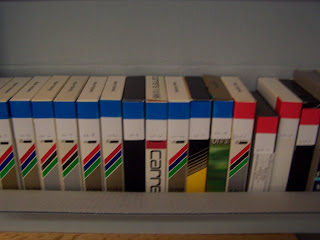 Norman Rockwell Museum has been awarded archival support through a generous grant from the National Endowment for the Humanities (NEH). The $85,000 grant will be used to reformat and process the Museum’s collection of magnetic videotapes, which contain hundreds of hours of important oral history and documentation related to Norman Rockwell and the art of illustration. The reformatting of the tapes will be handled by George Blood Safe Sound Archive in Philadelphia, Pennsylvania, with plans to make select films freely accessible to the public through the Museum’s website. Most of these tapes have not been viewed by the public before. They include unique interviews with Rockwell, his three sons, friends, colleagues, models, studio assistants and photographers, and other artists including Jan and Stan Berenstain, David Macaulay, New Yorker illustrators, and many more.

Monday, April 4, 2011
Model Citizen
Norman Rockwell spent the last 25 years of his life in Stockbridge, Massachusetts. The small town is now home to our Museum, which the artist personally helped to found. As a citizen of Stockbridge, Rockwell used local people to pose for his illustrations, many of whom still reside here. These familiar faces can be seen today at the local post office, the library, and other businesses along Main Street. A typical workday at the Museum might include a visit from a former Rockwell model, as they occasionally drop in to share their memories with us.
 |
| Norman Rockwell (1894-1978) "At last - settled in the new home and ready to welcome new neighbors and old friends!," 1961. Charcoal on paper. Norman Rockwell Museum Collection. ©NRLC, Niles, IL. |
Norman Rockwell spent the last 25 years of his life in Stockbridge, Massachusetts. The small town is now home to our Museum, which the artist personally helped to found. As a citizen of Stockbridge, Rockwell used local people to pose for his illustrations, many of whom still reside here. These familiar faces can be seen today at the local post office, the library, and other businesses along Main Street. A typical workday at the Museum might include a visit from a former Rockwell model, as they occasionally drop in to share their memories with us.
Recently, Elizabeth 'Betty' White stopped by the Archives. A longtime resident of Stockbridge, Betty and her family were invited to pose for many of Rockwell's illustrations. As Betty told her story, we looked through photographs and other documents in the Archives to search for additional details regarding her modeling session. A check register from 1959 revealed that Betty was paid $22 in October of that year to pose for one of Rockwell's illustrations for the Massachusetts Mutual Life Insurance Corporation (left). She was delighted to see images of her younger self, and of her children, who also posed for Rockwell. As we found out, the Massachusetts Mutual drawing which features Betty is a part of our collection here at the Museum. Before she left, the drawing was retrieved from storage so that Betty could view it for the first time.
We feel fortunate to be able to connect with these members of our community. Their insights into Rockwell's personality and process is invaluable, and as with all of our visitors and researchers, it is a delight to share our collections with them.
 |
| A check register from 1959 reveals Norman Rockwell's $22 payment to Betty White for her modeling session. Norman Rockwell Museum Archives. |
Tuesday, March 1, 2011
Caring for Your Collections

Saturday, March 5th, at the Norman Rockwell Museum in Stockbridge Curator Corry Kanzenberg and Archivist Jessika Drmacich discuss and answer questions regarding the care of home collections!
Discover how factors one might easily dismiss can wreak havoc on treasured photographs, letters, and home videos. These include direct sunlight, mold infestations, and incorrect temperature and humidity.
Listen to guidelines on basic storage, preservation techniques for sentimental letters from one's grandparents or old family photographs.
One can greatly extend the life of personal archives with the adoption of these basic storing and handling practices.
Come join us!
Wednesday, February 9, 2011


Thursday, January 27, 2011
What Price Glory?
 |
| Unidentified Man, J.C. Leyendecker, Unidentified Woman, and Norman Rockwell, April, 1925. Detail of photo by White Studio, New York, New York. |
In September of 1924, a new play written by Maxwell Anderson and Laurence Stallings opened on Broadway at the Plymouth Theater in Manhattan. The show was titled, What Price Glory?, and featured American marines in France during the first World War. Over the course of one year, it was performed over four hundred times. The theatrical production has since been remade into several feature-length films, including a version directed by John Ford in 1952, which starred James Cagney.
In the spring of 1925, with the help of local businesses, the play's management and cast organized a fundraising event, the proceeds from which went towards various veterans' charities. In addition to three days of benefit dances, a What Price Glory? poster contest was organized that featured illustrations made by men who served in the armed forces. Winners of the competition were awarded prizes by Arthur Hopkins, the play's producer. A photograph within our Archives identifies the judges, which included Norman Rockwell, and J.C. Leyendecker. Well-known for his advertising images commissioned by Arrow Shirt Collars, and House of Kuppenheimer, Leyendecker was Rockwell's friend and a fellow illustrator for The Saturday Evening Post. This photo is one of the few known images of the artist. Celebrities of their time, turn-of-the-century American illustrators were often invited to judge contests concerning art and beauty. On several occasions, Rockwell served as a juror for the Miss America Pageant while in the company of artists Dean Cornwell, and Howard Chandler Christy.
This photo was taken by White Studio, a commercial photographic firm with strong ties to New York's theater industry. Luther White, the studio's founder, has been credited with the development of flash-pan artificial lighting (NYPL, 2011). The New York Public Library is home to over 175,000 photoprints taken by White Studio between 1903 and 1936, a collection considered to be the most comprehensive documentation of the American stage from that period.
References:
"Poster show to help soldiers: Programs at Plymouth Theatre for benefit of the wounded veterans." (1925, April 19). The New York Times (1923-Current file), X8. Retrieved January 27, 2011, from ProQuest Historical Newspapers, The New York Times (1851 - 2007). (Document ID: 98822612).
Posters exhibited for war charities: Marie Dressler in barmaid regalia at back-stage tea at the Plymouth Theatre. (1925, April 21). The New York Times (1923-Current file), p. 18. Retrieved January 27, 2011, from ProQuest Historical Newspapers, The New York Times (1851 - 2007). (Document ID: 101657530).
New York Public Library. (2011). "White studio theatrical photographs." Retrieved from http://catalog.nypl.org/record=b16187984~S1

Wednesday, December 15, 2010
Why Archival Collections Matter in a Museum!
 My goal! (image from the University of Maryland Archives)
Part of the role of the museum archivist is justification. The cultural history of museums, as institutions, relies fully on item level description. Often, this is how the museum archives were organized prior to the hiring of an archival professional. Item level description, for archival records, overwhelms the scholar with unnecessary detail. Knowing that groups of records share certain characteristics, collective description relates the more important aspects of the archival material without repetition.
Deborah Wythe writes in her seminal book "Museum Archives- An Introduction:" (2004) "one of the greatest administrative challenges a museum archivist faces is the pressure towards item description. Museums thrive on item-level description. A ceremonial pot containing seventeen pebbles will be described as such, and each pebble receives accession numbers so that they can be tracked. Even in the context of the other, related vessels, it is most important as a single, unique item. You may be encouraged to 'catalog' individual items this way, a method that does not fully exploit the full power of archival description. A cubic foot of correspondence files is not equivalent to one pot, or several hundred pots, and an important part of your job will be to justify describing archival collections as groups, not items."
Facing the daunting challenge of the Norman Rockwell Museum Archives, where literally none of the records were organized according archival standard, is an immense undertaking. Acting as an archival detective, I must discover the provenance and "find" their corresponding collection. This is the exciting part of my job. For instance, some collections make sense in regards to donor and other collections are based on item type, others to provenance (Example: Norman Rockwell Photographic Print Collection, Norman Rockwell Collected Correspondence, Norman Rockwell Museum Moving Image Collection). These are the meaningful relationships that make archival descriptions for archival material non-negotiable in a museum environment.
An archival digital image, as an item floating in collections management software may be searchable via item type, name, accession number, or donor. But, this item makes much more sense if we can view it based on archival hierarchy. When we see the image with other images in the manner of organization the creator of the records intended, a story begins to emerge. In the particular case of Norman Rockwell, his archival material as collections allows a researcher to see his development as an artist; hence, new revisionist viewpoints emerge beyond traditional understandings of history, contributing to an evolving discourse.
Archival collections remind us that history is interrelated, not set in stone, and always an interpretation.
Monday, December 6, 2010
Found on Film
Welcome to the new blog of the Norman Rockwell Museum Archives! You can follow my posts (CorryK) for short contextual discussions regarding our latest archival aquisitions, items of recent discovery, and interesting documents retrieved during the process of research. Below is the text of my first post, Found on Film.
--------------------------------------------------------------------------------------------------------
In 1971, a public relations firm in the service of the McDonald's restaurant chain, successfully recruited Norman Rockwell to produce a cover illustration for the corporation's annual report. Often, representatives of the entities who commissioned Rockwell's work would personally visit with him when a piece was completed. For many, an exclusive meeting with the celebrity artist was an exciting and unique opportunity. In some cases, these guests had renown of their own. Such was the case of Ray Kroc, founder of McDonald's, who called on Rockwell in 1971 to collect the illustration commissioned by his company. Rockwell's studio photographer was on hand to document the occasion.
In 1971, a public relations firm in the service of the McDonald's restaurant chain, successfully recruited Norman Rockwell to produce a cover illustration for the corporation's annual report. Often, representatives of the entities who commissioned Rockwell's work would personally visit with him when a piece was completed. For many, an exclusive meeting with the celebrity artist was an exciting and unique opportunity. In some cases, these guests had renown of their own. Such was the case of Ray Kroc, founder of McDonald's, who called on Rockwell in 1971 to collect the illustration commissioned by his company. Rockwell's studio photographer was on hand to document the occasion.
 |
| Ray Croc with Norman Rockwell, Stockbridge, MA, 1971. Photo by Louie Lamone. Norman Rockwell Studio Negative Collection, Norman Rockwell Museum. Licensed by Norman Rockwell Licensing Company, Niles, IL. |
The Museum's three photos of Rockwell and Croc were recently identified in a large collection of the artist's studio negatives. They are among numerous others in the Archives which feature Rockwell and notable individuals such as John Wayne, Colonel Harland Sanders, John F. Kennedy, Lyndon Johnson, and Frank Sinatra. For staff of the Museum, it gives us pause to come across pictures like these, as there is something remarkable about seemingly disparate historical figures immortalized together in a photographic image. Could either Croc or Rockwell have foreseen one another's long-lasting impact on American culture?
Subscribe to:
Posts (Atom)